

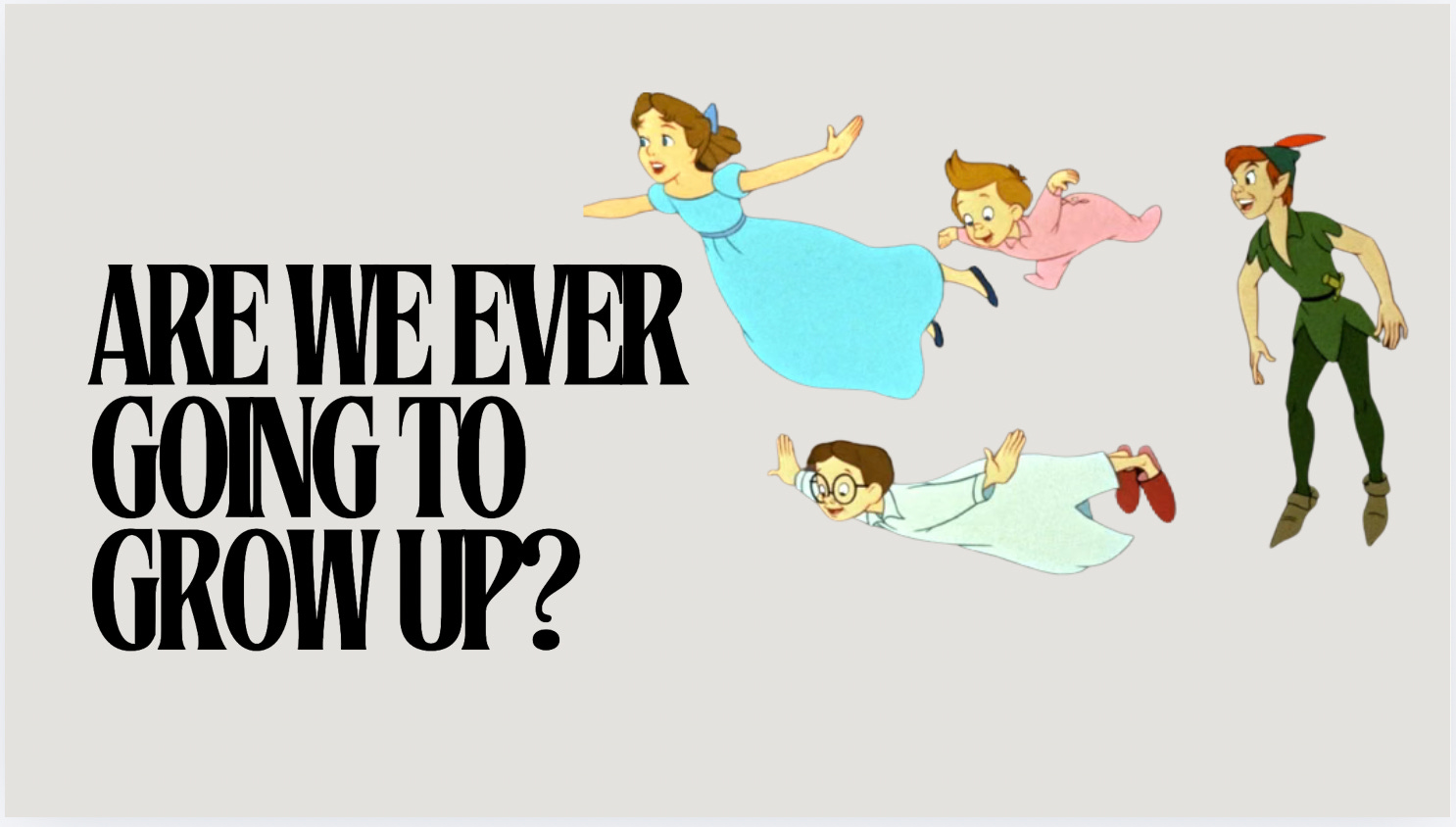
I turn 30 this year. I thought I’d feel like an adult by now.
Instead, here’s an audit of my life. I rent an apartment without a dishwasher. I spend most of the week in sweatpants. My bed is a multi-purpose surface — half of it is permanently covered in a laptop, a stack of books I keep meaning to finish, and laundry I have not committed to either folding or wearing.
Sure, I have a savings account, a 401(k), a CFP designation. And yet I keep waiting to feel like the person on the other side of the threshold. The version of me who has, you know, figured it out.
I am not, to be clear, having a crisis about this. I have a life I like. I am pointing at a thing I think a lot of people my age are pointing at, in different ways, all at once.
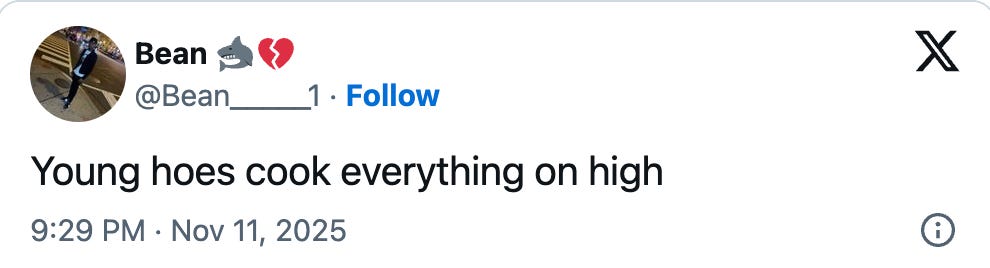
Look at the internet. Half the trends going viral right now are of people cheerfully cataloguing the habits that mark them as not-quite-grown-ups. Being a #youngho. Bed rotting. Girl dinner. (Eight tortilla chips, half an avocado, and a glass of wine.) Boy dinner (Or boy kibble). Girl math. I’m just a girl. The embrace of “whimsy” or nostalgia.
Or look away from the screen and out into the world, where adults are collecting toys instead of buying a house. Or watching cartoons, or reading books about teenage love triangles, or going to Disney world (sans kids) or drawing all over the tablecloth of a restaurant
.Underneath that aesthetic — and inseparable from it — is the structural picture. We are not buying houses. We are not getting married. We are not having kids, or we are having them later. We live with our parents at rates the U.S. hasn’t seen since the Great Depression. We are anxious. We are medicated. We have, as a generation, a recognized clinical disorder named after a 2006 Matthew McConaughey romcom.
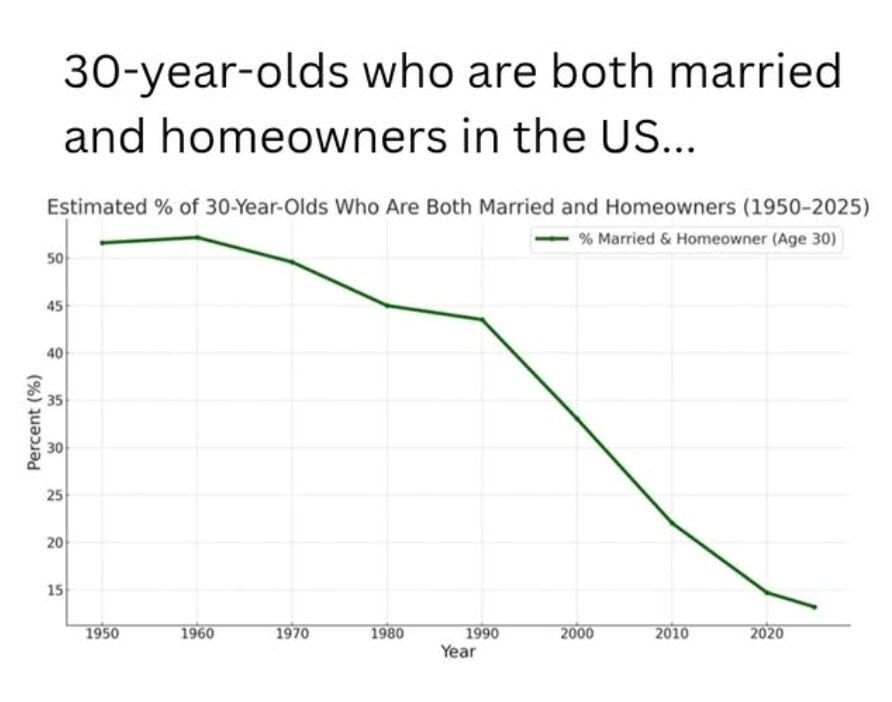
The dominant framing of this is that the problem is us. Our screen time. Our dopamine. Our refusal to be serious people. Why won’t kids today grow up? Read implicitly: what’s wrong with them?
That question bores me (the answer is pretty rooted in late-stage capitalism, I’ve written and talked about it many times over). The more interesting question to ask is, What then, happens to a whole generation that never grows up?
When the structural markers of adulthood get withdrawn, what fills the gap? Specifically, where does the money go?
When the structural conditions of adulthood become unreachable, you have two options.
You can consciously redefine adulthood — figure out what you actually want, what’s actually serving you, what a good life looks like for you specifically. Or you can lapse into the aesthetic of adulthood, in one direction or the other. Which is heavily marketed at you. Which feels safe. Which costs money.
Most people, including me on a lot of days, are doing the second without realizing the first is available.
Let me show you what I mean.
The economic context (briefly, because you’ve heard it)
You know the litany. Young people can’t afford homes. Young people can’t find jobs. If they have a job, they’re miserable. The career arc that used to come with stability— start at the bottom, get promoted, retire with a solid benefit — has been replaced with gig work, contractor status, “independent” labor that produces no benefits and no equity.
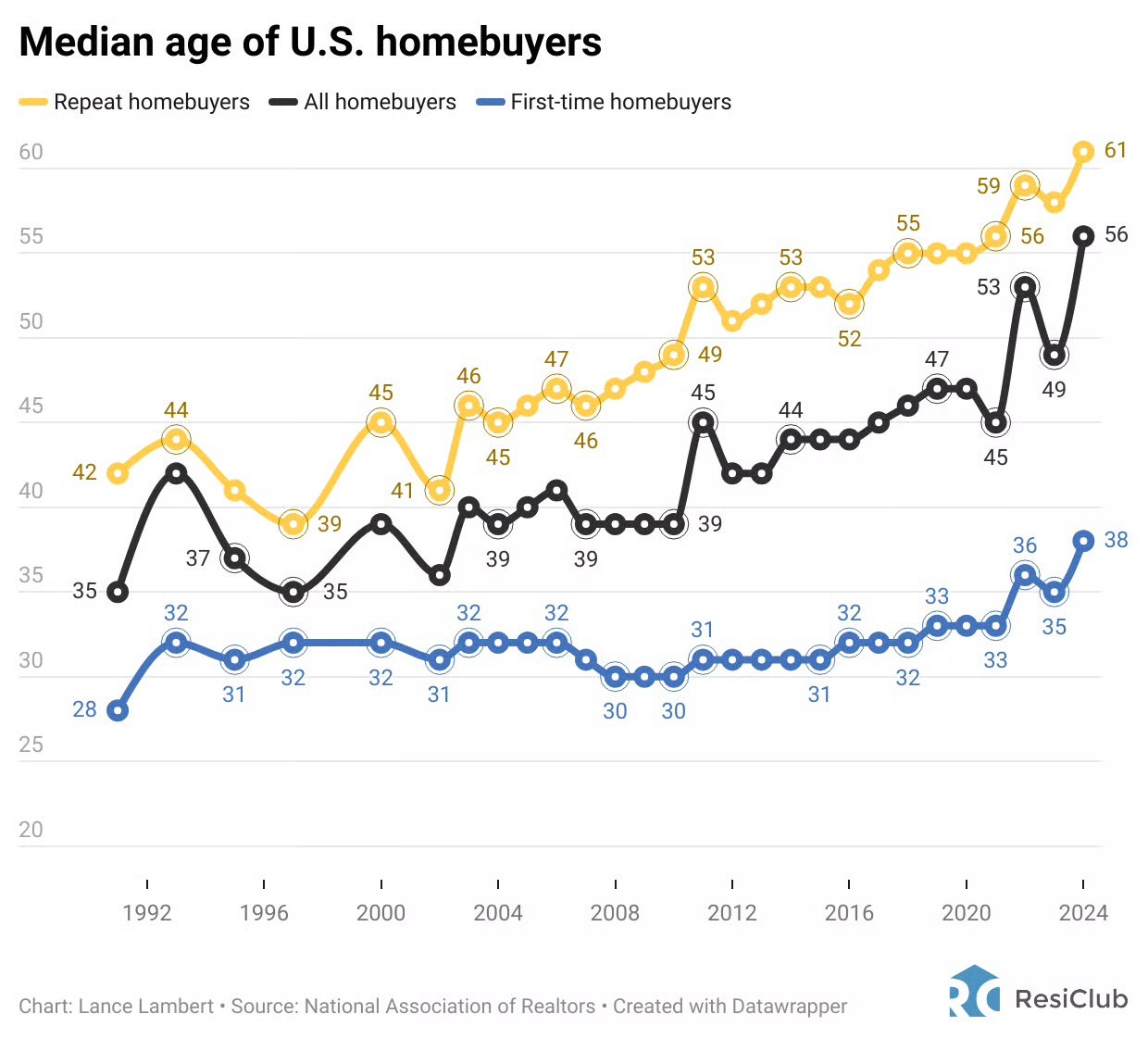
Young people are lugging around tens of thousands of dollars of student loan debt. Childcare costs more than rent in most U.S. states. Healthcare is rationed by deductible and tied to your employer, so many young people either don’t have it, are married to someone who has it, paying a shitton of money for it, or are stuck at a job they hate because of it.
There’s more to be said, but I have written about most of it already. I am not going to relitigate the case here. The question I want to spend the rest of this essay on is what all that does to how we behave with money.
Where the money goes
What happens to your relationship with money when the bundle of adulthood you were promised does not arrive on schedule, or at all?
We’re spending money on stupid stuff, and we know it
Last year, adults camped out overnight — overnight! — outside Starbucks for the chance to buy a stuffed bear ornament called the Bearista. They sold out in minutes. They were resold on eBay for $200, $400, $600. There were people getting in literal fistfights in a parking lot over a hunk of plastic.
Who can forget the Stanley Cup riots a few years back? Or the Sonny Angels? Or Labubus (of course). Or Funko Pops, LEGOs, Jellycats, Squishmallows … the list goes on. Kidults are driving hundreds of billions of sales in the toy industry.

Sure, some of these things could be arguably considered a collectible, sold eventually for a tidy profit. There’s nothing wrong with owning a stuffed animal (I have a large white bear aptly named, Mr. Bear). Some of these objects bring people genuine joy. You are allowed to enjoy things!!!
The problem is the part I’ve written about before — that under late-stage capitalism, the line between I want this and I have been sold the want is very thin. Most people, most of the time, do not realize the difference. They feel the want, they buy the thing, they tell themselves a story about why. The story is almost never that an algorithm trained on ten million data points decided this object would convert them at this exact moment of their life. But that is, increasingly, exactly what happened.
The “bundle” of adulthood — house, marriage, kids, stable career, retirement on the horizon — used to do double duty. It was an economic arrangement and an identity. Your parents knew who they were partly because of what they had done and what they owned. Married, two kids, owns the duplex on Maple. It told them. It told other people. It gave their lives a shape with a beginning, a middle, and an arc you could describe at a dinner party in three sentences.
When that goes away, you fill the gap with stuff. Disney adult. Gym girlie. Financebro. Pilates princess. Clean girlie. Run club guy. Many of these full-stack identities are tied to a specific consumption pattern, performed publicly online. We do not own anything. We are subscribers. To brands, to aesthetics, to communities organized around what we buy.
This is also, I think, the structural reason “stan” culture exploded the way it did. Being a Swiftie, for example, gives you a legible identity category (it’s also based heavily around consumerism). Online fan communities are also highly functional social structures with their own norms, hierarchies, in-jokes, and belonging rituals.
Traditional adulthood also gives you a story arc. Meet partner, buy house, have kids, build toward retirement. Milestones give life punctuation. Engagement parties, house warmings, baby showers. In our society, we don’t tend to celebrate things that aren’t connected to turning a year older, getting married, or having a baby.
If you don’t have those things to celebrate (and don’t create that meaning for yourself, which I’ll get to), you may wind up latching onto events like concert dates, game releases, merch drops, and unboxing events.
The companies, of course, have caught on. Which is why every new product is dripping with nostalgia and we have the resurrection of every dormant millennial IP for a generation with money to spend and no future to spend it on.

This is the same culture that says you cannot have a house is also saying here is a stuffed bear, a $40 plush fish, an entire Disney park designed for you, please come spend $400 on us this weekend. Capitalism is selling, very efficiently, the only product whose value proposition still makes sense: the feeling of being taken care of, in an economy that has stopped taking care of you.
We can’t afford the substance of adulthood, so we’ve been sold the aesthetic
The opposite side of the coin: Instead of regressing visibly into the child you can afford to be, you optimize ferociously into the adult you can’t.
This is the morning routine industrial complex. The supplement stack. The 5-to-9 before the 9-to-5. The Notion template. The labeled pantry. The hyper-curated apartment. The wellness routine elaborate enough to require its own spreadsheet. The financial influencer’s $89 course on “how to budget like a CFO.” The morning shed.
I wrote about “maxxing” this earlier this year — the optimization of every variable of selfhood, the gamification of personhood, the conviction that if you tweak the right inputs you can engineer your way into a different life. A main point in that essay is that maxxing is not just about optimizing yourself. It is about performing maturity in the absence of the conditions that used to produce it.

When you can’t afford the substance of adulthood, when everything around you feels out of control, you try to grasp and control what you can, via optimization. You self-soothe through buying things. The performance of competence is cheaper than the substance of it, and, conveniently, more shareable.
What this maps onto is older productivity-as-virtue tropes adapted to an audience whose actual productive output, by economic necessity, is no longer the thing being optimized. We optimize the appearance of being optimized. We make the morning routine TikTok. We don’t, on the back end, own anything more than we did last year.
We are not, in fact, not serious people. We are taking ourselves desperately, exhaustingly seriously. Just in the wrong direction.
The future got harder to picture, so we stopped saving for it
Adulthood, as a developmental concept, is essentially a relationship to time. It’s the capacity to defer, to plan, to act on behalf of a future self you can imagine.
The entire personal finance industry is built on that capacity. The 30-year mortgage assumes you can imagine 30 years from now. The 401(k) assumes you can imagine yourself at 65.
What happens when the future stops being imaginable?
When you cannot picture the math that gets you to a house. When retirement is something your parents had and your friends joke about not having. When the version of yourself who owns things, who is settled, who has arrived — when that person is not someone you can place in a real apartment in a real city in a real year.
The rational move is to optimize for the part of the timeline you can actually see. This week. Tonight. The next paycheck. Right now.
That’s the psychological base of instant gratification culture. And of the casino economy that came with it. I want to get rich and have a lot of stuff, and I want it now. I don’t want to deprive myself in any way, I don’t want to do the slow and boring thing because the slow and boring thing is for a future that may not even exist.
Many people my age live paycheck-to-paycheck. There’s of course a structural layer to this, but it’s also partly because their thought process is, What’s the point? Financial nihilism.
So what do we do with this?
Adulthood used to be sold in a package — which made it easier to go along with and understand but much more difficult if you didn’t want to.
You did house, husband, kids, in that order, because that’s what was available and that’s what was expected. In generations past, there were real social and economic costs to questioning the package — especially for women.
The bundle wasn’t only an economic arrangement; it was a cultural enforcement mechanism, and the enforcement fell hardest on women, on queer people, on anyone whose actual life didn’t fit the norm.
That enforcement has, at least somewhat, softened. Which means a lot of people my age are getting to ask a question their parents never had ability to ask: what kind of life do I actually want?
Some of the things people my age are choosing — to delay marriage, to not have kids, to not buy a house in the suburbs we grew up in, to live with friends in their thirties, to channel income toward travel or freelance autonomy or community instead of equity — are not failures of adulthood. They are, in a real way, the first generation broadly able to make those choices without paying a steep cultural penalty.
That is progress. It’s mistakenly read as general decline, mostly by people who couldn’t make those choices themselves and assumed everyone else also wanted what they had.
So part of what I’m arguing for is not a return to the everyone-follows-the-same-script road to adulthood. Instead, I’m arguing for the ability to define adulthood on your own terms, without external interests (read: consumerism or social pressure) defining it for you.
Some of the markers I am missing, I do not actually want. I do not want a 30-year mortgage on a house I cannot really afford in a neighborhood I do not want to live in, because the idea of homeownership has been sold to me as the prerequisite for being a serious person. I want stable housing. The mortgage is one route to that. It is not the only one, and it is not the only thing I should be measuring myself against.
Some of the markers I am missing, I do want, though I’m going to have to figure out a less linear way to get there than the one my parents had.
And some of the things I do that look like arrested development — the apartment, the sweatpants, the laundry on the bed — may not actually be the problem. They are the surface of a question I haven’t asked clearly enough yet, which is: what would I be doing instead, if the milestones were available? Honestly, in a lot of cases, the answer is: probably the same thing with slightly less guilt about it.
I came across Kareem Rahma’s (from Subway Takes notoriety) essay on the infantilization of millennials, and I was piqued by this:
“Brands and corporations treat us like children, and we buy into it. As a result, we feel increasingly incapable of doing adult things like buying a house, getting married, having kids, or starting businesses. Yes, I know these things are hard. I know that the economy sucks. I know that AI is taking our jobs. I know that there are other factors at play. I know that some of you don’t want any of these things at all! I know we’ve been dealt the wrong hand. But I feel like participating in the Branded Content Adult Spelling Bee is not helping. I feel like we should be doing something else like maybe revolting?”
The redefinition of adulthood I am calling for is partly personal: figure out what you actually want. But it is also quite political. The system that made adulthood unaffordable is going to keep making it unaffordable until enough of us refuse to keep paying for the version it’s selling.
I don’t know if I’ll feel like an adult when I turn 30 this year. Honestly, probably not. But I’m starting to think the people who eventually do — the ones who feel, somewhere in their thirties or forties, like they’ve arrived — will be the ones who looked at adulthood, decided what they actually wanted out of it, and built that.
I’m 40. I graduated into the Recession. I didn’t even get a job job until I was 28, let alone one that paid a truly living wage. I got that at 32, and it paid $60,000, not 6 figures.
One difference I observe in my college-educated peers who are 10-15 years younger than me - and please correct me if I’m wrong - is that the goalposts of true adulthood keep moving to be harder to obtain.
One goalpost that keeps moving is related to my $45,000/yr first job! Too many people think the only good jobs are the ones that start at $100,000. That isn’t even true, and it’s only getting worse as people flooded into compsci program to access these unicorn tech jobs (which had their own detriments) that now no longer exist because the market is flooded. My elite SLAC students all now want to go direct to becoming extremely high paid specialists (cardiologists, specialty dentists, medical researchers), and will take on $100,000s of debt and be in school into their mid-30s to avoid having to work a lower level job. This seems very risky and foolish, because a lot of people have no idea if they are even occupationally suited for, say, healthcare until they are in med school. They keep themselves in walled pay-for-play environments until they can make what is deemed an “adult” salary. This delays adulthood further and also doesn’t help them develop adaptability.
Another example: homeownership can include condos or apartments, which in many metros (though not the top 3-4 most expensive) can be more attainable for a young person than a single family home. And, a condo purchase can be leveraged into a single family home down the line.
However, I’m noticing more and more young people who think the only option is single family home in the perfect neighborhood. This belief is not new, but I wonder if it’s more common. When I bought my condo at 30, my peers were slightly negative about my choice. Instead of congratulating me, I often heard rude comments about “wasting my money on HOA fees” (how much did you pay to replace your roof/mainline in the first year of owning your home? Oh, $15,000? My HOA fees cover that) or about how terrible it is to share walls. Even for older Millennials, there was a preference to only buy the SFH. I’ve observed that this preference has only crystallized. My 30yo friend bought a townhouse with his husband, and they both got weird shit from peers and even their realtor.
Another thing I notice is the luxury-dorm-to-luxury-1BR-apartment pipeline. I was able to afford a 1BR condo at 30 making $45,000/yr at an unstable job in part because I lived with roommates my entire 20s. This is how I was able to save money for a modest downpayment for a condo. I notice more and more of my younger peers do not want roommates at all in their 20s. That’s a huge rent burden to take on, especially on a typical 20 something wage. (There are also social benefits to living in shared living situations. all of my friends came through roommates. I learned a lot of conflicted resolution and compromise skills by living with roommates.)
I also understand that it feels like a step down to go from your parents’ nice house, to your luxury dorm in a college neighborhood (funded by parents and/or loans) to a 2-4BR apartment in a neighborhood you can afford on a 20something wage. I think it is actually probably beneficial to live in a shitty tiny dorm room with a random roommate at least 1 year because it breaks the chain of high quality housing and gives more realistic expectations of what living within your means in your 20s looks like and the skills (and self-efficacy) to do so.
And, I don’t think this is completely the fault of younger people! I’m not one of those “kids these days” people. The experiences of Gen Z are borne from the same economic collapse that really harmed older Millennials. In fact, the trends in housing preference Ive observed were common in Millennials too.
Moreover, colleges and universities have invested heavily in property development as a post-2008 financial strategy. They’ve also invested in luxury dorms as a strategy to woo the decreasing number of students with wealthier parents and extract more money from them. When I started college, it was much more normal for all freshman to live in the crappiest dorms, and colleges expected parents (and students) to deal. Upper classmen got the better dorms. It was part of the experience.
I feel like younger millennials and Gen Z (and their parents) were preyed on by universities to extract more money. Once there were tiered housing options at different prices for freshmen, then there was a pathway to never having to share or compromise. This also really moved the goalposts.
Really true that it's not just an economic arrangement and that adulting is also very cultural. There's a lot in singlehood studies about this and the way in which people who never get married or have children are treated as less than an adult. Same as not buying a house, but different. Adulthood is a cultural and economic package and a lot of us have never bought the full subscription - and even people who want to can't.