

Your inbox is a wasteland of “FINAL HOURS” and “LAST CHANCE” subject lines. Your Instagram feed is people unboxing things they just bought, which makes you think about things you should buy, which leads you down a rabbit hole of comparison shopping for products you didn’t know existed 47 minutes ago.

Ah, holiday spending season — where retailers have spent the entire year studying your psychological weak points and are now deploying every dark pattern in the playbook to make you spend money you don’t have on gifts (probably) no one asked for.
Let’s break this down, because IMO the headline numbers most definitely do NOT reflect what is going on beneath the surface.
💸 MONEY MOVES
Holiday spending is up — and retailers are playing you like a fiddle
Despite everything — despite inflation, despite economic anxiety, despite the general sense that things are getting harder — Americans have increased their holiday shopping budgets since summer, the Headlines Are Saying. According to a recent survey, shoppers are planning to spend more this year, with Gen Z and Boomers leading the charge.
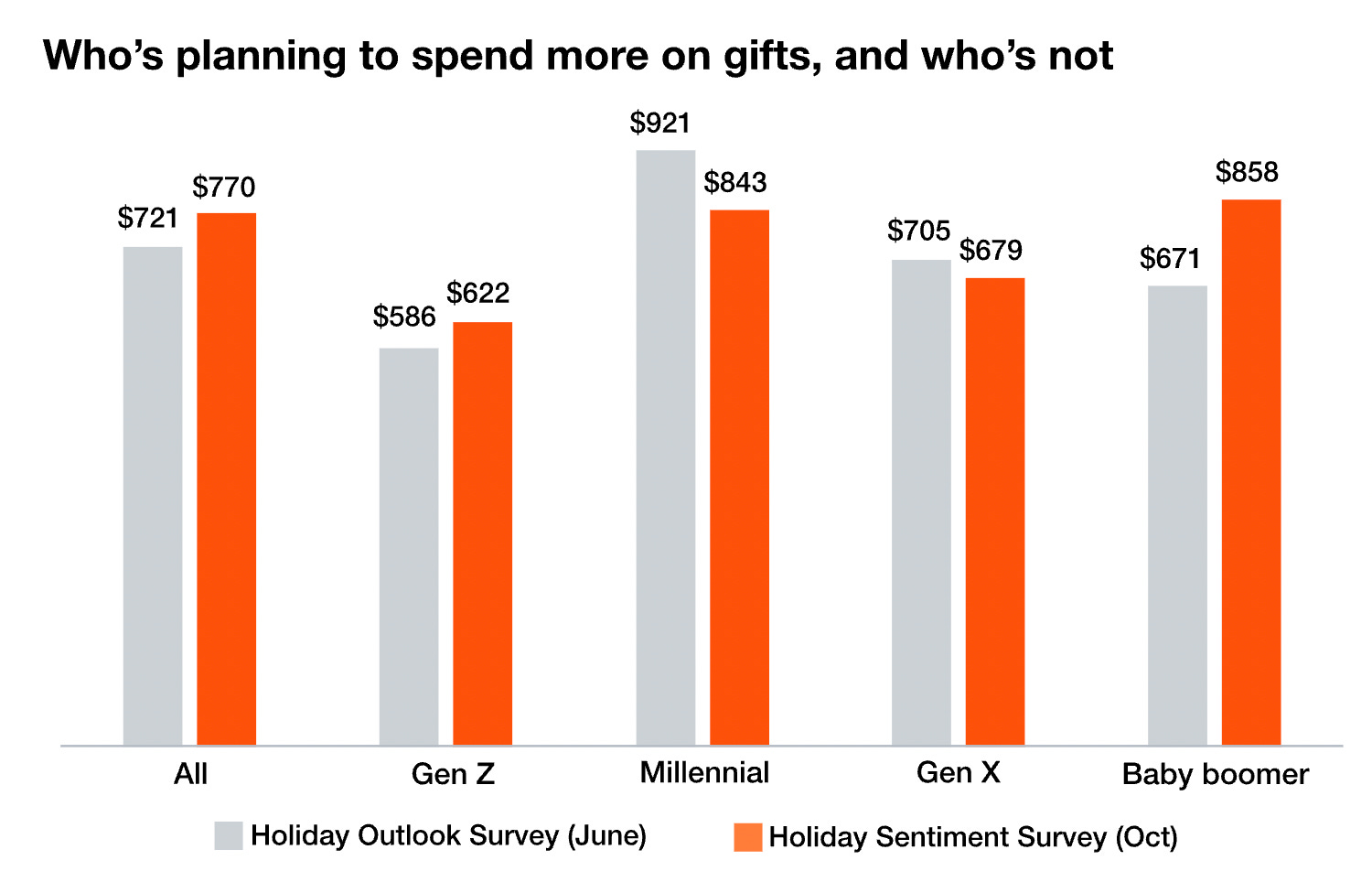
Americans plan to spend an average of $2,800 this holiday season, an increase of more than $1,000 from last year.
You might think this spending surge means people are feeling more financially secure, or that people are just super irresponsible and just cannot. stop. spending. And maybe those things are partially true.
But I would argue this increase in spending can be attributed to two major things:
a) inflation, which is driving rising costs, which means you’re paying more for the same amount of stuff as last year
b) buy now, pay later
What the headlines are missing is that: This isn’t a story about consumer confidence or holiday cheer. It’s a story about a K-shaped economy held together by financing mechanisms that make everyone look more financially sound than they actually are.
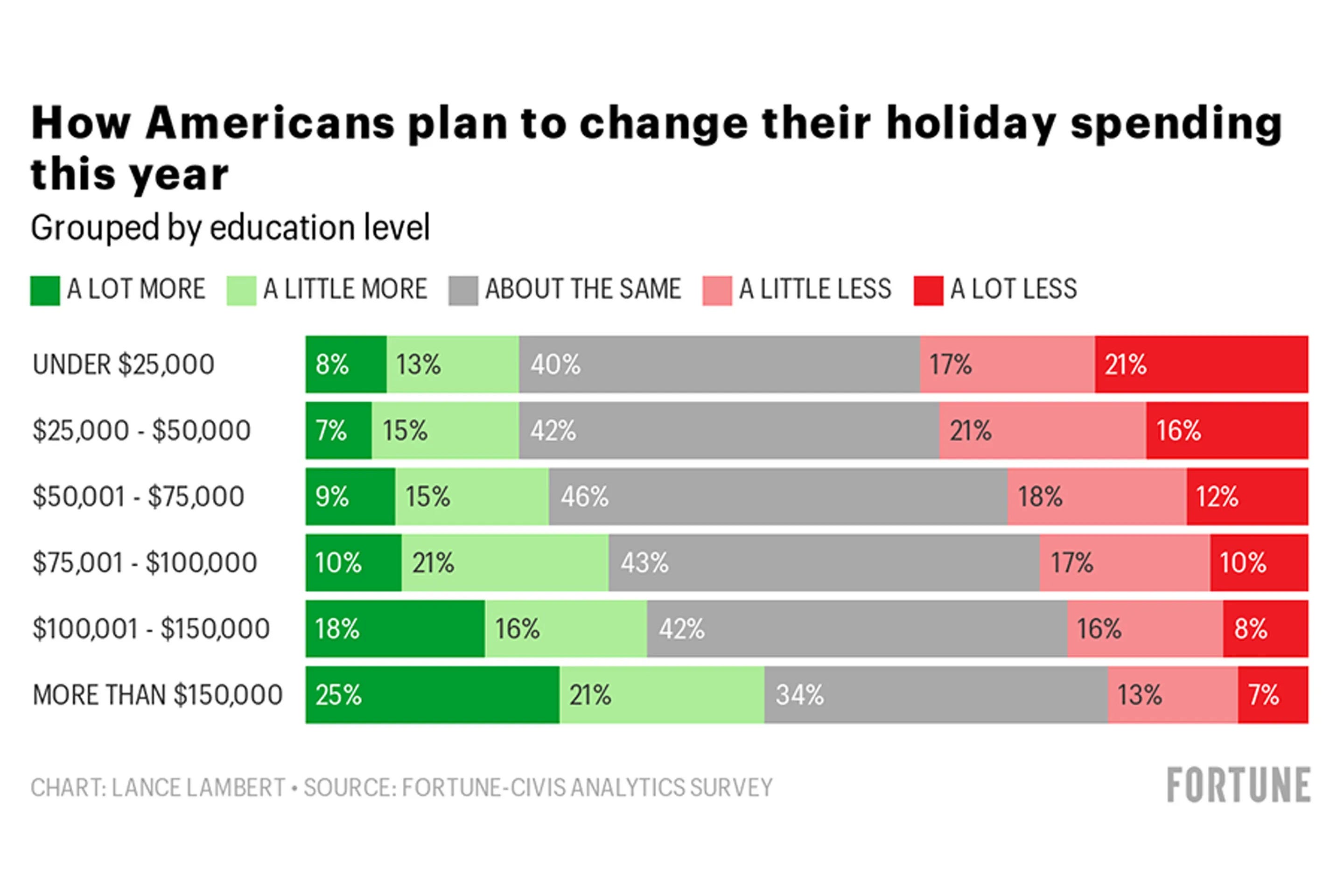
As I’ve written about before, the top 10% of earners now account for nearly half of all consumer spending — the highest share ever. Baby boomers with substantial real estate and stock portfolios are boosting their holiday spending by 21% this year, riding a wealth effect where assets near all-time highs make them feel richer even if their actual income hasn’t moved. The stock market is creating spending power for people who already have money.
Meanwhile, the bottom 80% … When adjusted for inflation, the actual amount of stuff people are buying is barely growing — prices are just up. Consumer confidence is in the tank. People are anxious about inflation, a weakening job market, and employers freezing hiring.
But people are continuing to spend anyways, absorbing higher food prices, struggling with rising credit card debt, and increasingly turning to buy now, pay later.
Sixty-four percent of all Black Friday shoppers used credit cards or BNPL to afford their purchases. Half used some form of BNPL specifically.
That’s a structural shift in how Americans fund consumption — and it’s happening invisibly, off credit reports, making everyone look more creditworthy than they actually are while debt piles up across income levels.
So what’s the psychology here?
Maybe right now, you’re experiencing economic anxiety — you know things are harder, you see the news about layoffs and inflation — but you’re also trapped in a system where participation in consumption culture feels non-negotiable. BNPL doesn’t feel like debt; it feels like a hack, a way to maintain normalcy when everything else is slipping.
The genius of BNPL is that it makes the pain invisible. Instead of one crushing $400 credit card bill in January, you’ve got four $25 payments spread across different apps that don’t talk to each other. Your brain can’t aggregate that debt the way it would with a credit card statement. Each individual payment feels manageable, even though collectively you’re financing a lifestyle you can’t afford.
But underneath? Rising revolving debt. Increased BNPL usage masking financial stress. A growing gap between people who spend because they’re rich and people who spend because not spending would reveal they’re struggling.
🧠 NOT A PAID SUBSCRIBER YET?
You’re missing out on:
📋 My values-based budgeting spreadsheet – Stop fighting your psychology, work with it instead
🎯 Bi-weekly “Money Moves” column – Tactical advice on how to navigate the current economy.
🎙️ Monthly Office Hours – Where I answer your questions about money psychology, live
🍵 MONEY GOSSIP
Pour yourself some coffee and settle in for these links:
It’s tiiiiiiiimeeeee …. Mariah Carey has allegedly earned $80m+ in royalties from “All I Want for Christmas is You.”
It’s also time for luxury advent calendar season, which I (unfortunately) just discovered. Perhaps $950 for Gucci? $600 for YSL?
Ten people shared what they consider “life-changing money” and what they’d spend it on.
More than 72% of Gen Z believe renting is a better financial option than buying a home. And 83% say renting lets them save for “life experiences.”
A pocketwatch from the Titanic just sold for $2.3 million at auction. I genuinely need to know who’s buying this. Probably James Cameron.
Would you pay $1,999 a year to remove AI slop from your content feeds?
Americans are going to great lengths to save money: growing their own produce, watering down soap, buying half a cow.
Meanwhile, young urbanites are cutting back on their daily slop bowls (Chipotle, Cava, Sweetgreen) in an effort to save $20.
Still confused about why people camped overnight to spend $1,000 on a T-shirt? Quiet luxury isn’t quiet when you’re literally queuing for it.
New research shows 76% of consumers are more likely to buy something if a celebrity endorses it, and endorsements boost sales by an average of 4%. So yeah, expect more Sydney Sweeney, probs.
Obsessively following the escapades of this food influencer who allegedly dined and dashed through Williamsburg restaurants, photographing her food then skipping out on the bill. She owes $372 across three restaurants and is being held on $4,500 bail.
The Trump administration announced lower Medicare drug prices: A 30-day Ozempic supply will drop from $1,000 to about $275.
New research found that tariffs added 0.7 percentage points to August inflation. The annual rate was 2.9% — but would’ve been 2.2% without tariffs.
💡 LONG READS
Baby boomers’ property tax revolt (Business Insider): “A recent song, ‘Uplift the Dream,’ is one of 20 tracks on an AI-generated album specifically designed to rally support for eliminating Ohio’s property taxes.” This is a sentence I never, ever wanted to read, but here we are.
Wealthy New Yorkers who take the bus (Luke Savage): “When everyone uses or benefits from a program or service regardless of their income, it is transformed from a commodity into a shared good — something with intrinsic rather than strictly monetary value.” Essential reading on why means-testing everything destroys the social fabric.
I Can’t Afford A House, So Why Don’t I Just Be Gorgeous? (Bustle): “Many millennials are bringing in enough cash to splurge on their well-being, but maybe not enough to reach more traditional financial goals, like buying a home and affording children. Caught in the middle, many are taking the same approach: ‘I don’t have enough money for these bigger investments, so why don’t I just be gorgeous?’”
LAST THING...
I love my job. I make a great salary, there’s a clear path to promotion, and a never-ending supply of cold brew in the office. And even though my job requires me to commit sociopathic acts of evil that directly contribute to making the world a measurably worse place from Monday through Friday, five days a week, from morning to night, outside work, I’m actually a really good person. (Source)
If this roundup made you think differently about your holiday spending, forward it to someone who needs to read this.
P.S. What’s the most manipulative “sale” you’ve seen this season? Hit reply — I’m collecting examples.
See you Wednesday for the deep dive,
—Hanna