

Good morning - I am finally back in NYC. Missed you. Let’s get into the news, shall we?
💸 AI Is making work harder, not easier
When generative AI started going mainstream a few years ago, the pitch was almost utopian. Tech founders were talking about universal basic income because, supposedly, AI would handle so much of our work that we’d need a new economic model. The promise was that machines handle the drudgery, you get to spend your time on creative, meaningful work. Maybe even work less.
Instead, what’s happening right now is: People are getting laid off in the name of AI, and the people who still have jobs are drowning in more work than ever.
Jack Dorsey announced last week that he’s cutting nearly half the staff at Block. His reasoning was that “intelligence tools have changed what it means to build and run a company.” Which, sure. Or maybe Block overhired during the pandemic boom and “AI transformation” sounds a lot better in a shareholder letter than “we messed up our headcount projections.” We will never know!
This follows an ongoing wave of AI-justified layoffs across the tech and SaaS industries. Andrew Yang says mass white-collar layoffs are “closer than people think.” A doomerist article on Twitter (not calling it the other thing) predicting market crashes and mass unemployment went viral. There’s now a clinical term for workers who are constantly stressed about being replaced by AI.
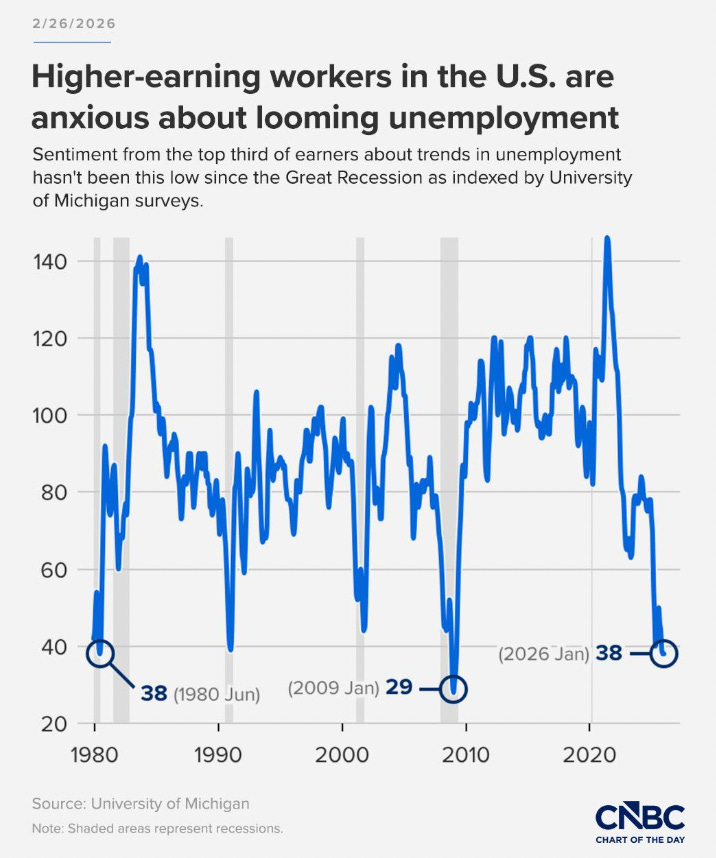
And yet … a new study confirmed what most people who actually use AI at work already suspected: it doesn’t reduce work. It intensifies it. Researchers found that while generative AI did boost some productivity metrics, it also made work bleed into people’s downtime and ratcheted up the overall intensity. So maybe you’re producing more. But you’re also likely more exhausted.
What do we even mean when we say “productivity”? The way we measure it is basically: did you produce more stuff? More emails. More reports. More slide decks. More Slack messages. There’s a term for this now — workslop. Harvard Business Review argues that AI-generated workslop is actually destroying productivity, because the time you save generating content gets eaten by the time everyone else spends wading through your AI-generated content.
We’ve built an entire economic framework around the idea that more output = more productive = more valuable. But what if more output just means … more noise? What if “productivity” as we’ve been defining it was always kind of a dumb way to measure whether work is actually good or useful?
For all the hype and all the anxiety and all the layoffs — Goldman Sachs calculated that massive AI investment contributed “basically zero” to U.S. economic growth last year. So we’re in this weird liminal space where:
AI is making existing work more intense
Companies are using AI as justification for layoffs
Workers are anxious about being replaced
But AI hasn’t actually improved productivity in any measurable way
We’re just getting the anxiety without the upside. And I think the reason this is affecting so many people isn’t purely financial (though, of course, money is a factor). Many white-collar workers have built their entire identities around knowledge work. When AI can do that (or claims to), the crisis can feel existential.
As Annie Lowrey wrote in The Atlantic, white-collar workers could face years of structural unemployment. But there’s something else at stake: the loss of an entire way of understanding yourself. For decades, young adults were pushed toward college, toward knowledge-work careers: software engineering, finance, consulting. Those are now the exact industries getting disrupted. Ironically, the age of AI is driving new respect for humanities skills.
There’s also another danger that isn’t getting enough attention: It isn’t just whether AI will replace workers. It’s who will control the knowledge that companies capture from their workers.
AI is going to continue to disrupt the job market and the broader economy for the time being. And right now, we’re living in the worst of all possible worlds: the layoffs, the anxiety, the intensification of work — and none of the promised liberation the tech billionaires promised.
I’m going deeper on this in Wednesday’s essay.
🔍 In other money news …

Credit card debt topped $1.28 trillion. The New York Fed’s latest data shows this is consistent with the K-shaped economic divide — the top is fine, everyone else is charging groceries. (CNBC)
S&P 500 and Nasdaq finished February in the red — driven by AI disruption fears (ironic, given today’s main story) and hotter-than-expected inflation data. (CNBC)
Speaking of AI and the stock market … As AI grows increasingly intertwined with equities, it’s going to be incredibly hard to protect your portfolio against it. You no longer have to own AI stocks to get AI exposure — it’s everywhere. (Money)

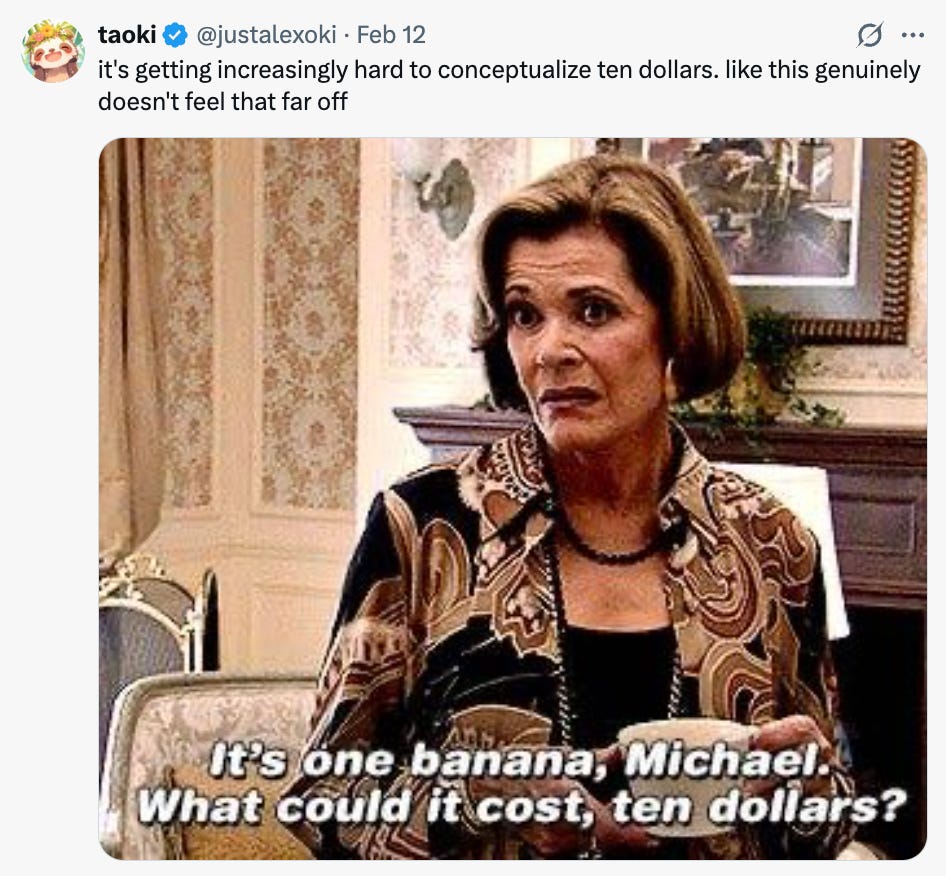
Tariffs are creating a consumer waiting game. Companies could decide to temper price increases as tariff policies shift, but the effect would take time to materialize. Also, companies could just … choose not to lower prices. Which is probably what will happen. (NYTimes)
MrBeast bought a bank. His company acquired Step, a Gen Z-focused fintech app. The YouTuber-to-financial-services pipeline is real and I have so many feelings about it.
🍵 MONEY GOSSIP
Airport lounges are so overcrowded they’ve lost their exclusivity, so travelers are going back to the airport bar.
The new avocado toast is rotisserie chicken.
Don’t worry, the investment bankers won’t starve.
Dating apps are starting to hide matches behind $20/month paywalls now. BOOOOO.
The last good thing about work trips may be ending.
Wait, men are emotional???
Turns out, when you use taxpayer money to directly help taxpayers … people respond well.
“Sleepcations” are now a thing, where people are booking hotels just to sleep. This is probably not a sign of a healthy society.
Some NYC private schools now charge $75,000 a year for kindergarten.
And lastly, a brief explainer on why concert tickets are a bajillion dollars.
💡 LONG READS
Clocked Out (The Point Mag) “At some level, almost everybody wants a good job, one stimulating and rewarding enough to be worth organizing their identity around. But should such jobs be considered a right? A privilege? Or is this vision of work a total fantasy?” A meditation on what we expect from work and whether those expectations were ever realistic.
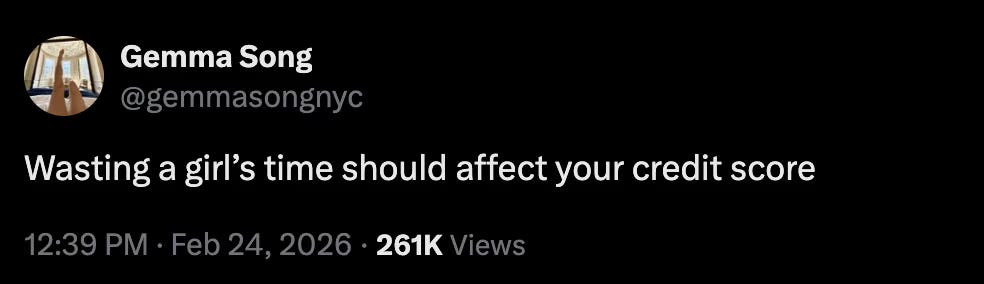
The Squeezed Winners (Grace Blakeley) “In an individualistic society, people often blame themselves when their economic situation deteriorates. This self-blame metastasizes into an inchoate rage, which is often directed towards convenient scapegoats. But individualism is not set in stone.” Sharp as always.
Buying Futures, Renting the Past (Kyla Scanlon) “Speculation (sports betting, crypto, prediction markets) and nostalgia are two sides of the same coin. One future-facing, one backwards-looking. Betting on Jesus returning by 2027 and watching the Backstreet Boys sing about crypto are the same behavior.” Kyla connecting prediction markets and nostalgia culture is the kind of synthesis I live for!!
Parting thoughts …
What I’m reading: Everything I Know About Love by Dolly Alderton. A sweet book about friendship and growing up. I liked Good Material better (a great post-breakup read), but this one reminds me how vital friendship can be — and how lucky I am to have the friends I do.
What I’m watching: Connor Storrie on SNL. Because why the hell not.
What I’m listening to: “True Love Will Find You in the End” by CryBaby.
If this roundup made you think differently about money, share it with someone who might appreciate a fresh perspective:
See you Wednesday.
Stay curious, Hanna
My gosh I'm so glad I found your publication, it makes me so happy to read in the morning (and makes me question my own publication style - for the better of course!)
This is a great perspective on the AI discourse and as someone who worked in corporate productivity for years, I can absolutely back up that it's mostly hype. There are a few actual use cases, but we do have to be very careful about the workslop.
I can't tell you how many times I had to send a follow up email to a "meeting minutes" email that was obvious AI generated and had tasks assigned to people that didn't exist or sentences that made absolutely no sense without the context from what was presented on screen (not captured by the meeting summary agent.)
“the time you save generating content gets eaten by the time everyone else spends wading through your AI-generated content.”
I’ve been trying to understand exactly why I feel MORE busy and overwhelmed than I did, say, a year ago at work. And that quote is exactly it. I work at a tech firm in a customer-facing role, and AI kind of feels like that coworker who doesn’t really do anything but insists on trying to prove its own relevance by pure verbosity and “insights.”
I get AI slop generated about clients before I meet with them (about 5% of it is helpful and true). I get AI slop from clients. They feed my responses into AI to generate an endless stream of follow-up questions that never allows us to “close the loop.”
It’s maddening and I’m exhausted.